

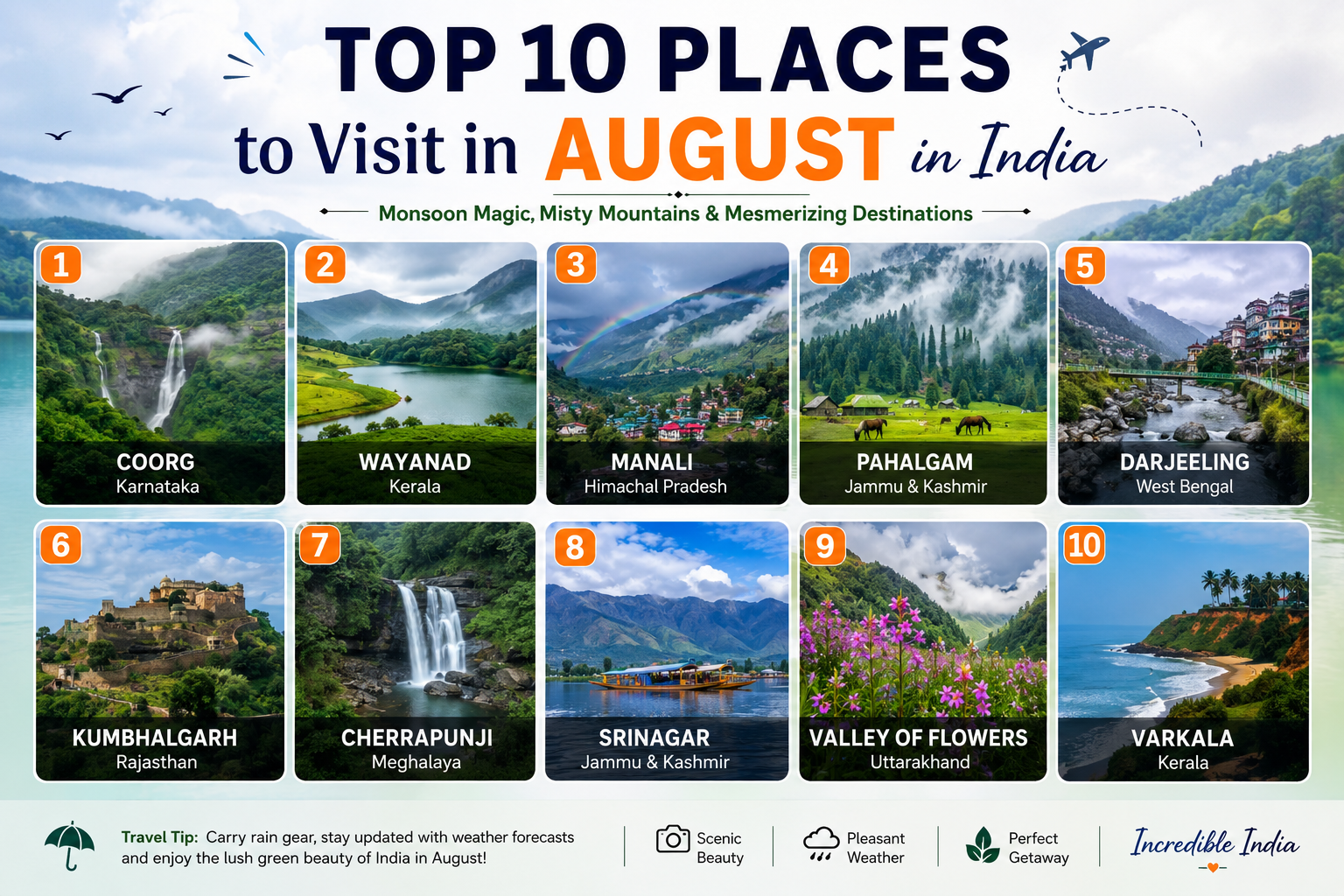
Top 10 Places to Visit in August in India
The month of August in India is a month many travelers overlook and that’s the reason why it is one of the best benefits. As the monsoon rains swoop through the Indian subcontinent in dramatic and sweeping sheets, they change the landscape into something stunning the way waterfalls cascade down cliffs which were dry a few weeks ago the rains, forests transform into an electric green and the air smells of the wet earth and blooming jasmine. The crowds diminish, prices decrease and India is revealed as a rawer and more genuine version.
August also has the vigor that comes with Independence Day, celebrated on the 15th of August with flag-raising ceremonies along with cultural programs and patriotic fervour in every part of the country. If you are a discerning traveler who is willing to accept a bit of rain, the month of August in India is among the most rewarding and affordable months to travel. Here are top 10 Places to Visit in August in India.
Top 10 Places to Visit in August in India
1. Coorg, Karnataka — Monsoon Paradise in the Western Ghats
If there’s a place in India designed for monsoon season then it’s Coorg. Karnataka’s hill station is within the Western Ghats, and August is when it attains the top in its beautiful, misty splendor. The estates of cardamom and coffee are ablaze with a deep, rich green. Abbey Falls thunders down a forested cliff in a force that will leave you breathless while the dawn mist flows across the valleys in hefty gentle waves. The air is fresh, fragrant and captivating.
The rains aren’t a deterrent for guests from coming here- they are the main reason for visiting. Coorg’s estate homestays are an ideal base for nature walks, bird watching and long nights of Kodava barbecue and coffee filter. Namdroling’s golden temples shine particularly beautifully against a monsoon sky. The Raja’s Seat location, covered in clouds, is to be at the end of the universe.
2. Alleppey, Kerala — The Backwaters at Their Most Romantic
Alleppey — also known as Alappuzha Alleppey is beautiful all the time and beautiful, but in August it gets an extra layer of drama. The backwaters rise with monsoon-driven water, transforming the entire network of canals, lagoons and lakes to a sparkling reflection, awashed with rain. The experience of floating through the watery labyrinth on a traditional kettuvallam homeboat and listening to the rain drum on the roof thatched with a tarp as a chef cooks Kerala seafood curry inside the galley is among the best memorable experiences that India provides.
The month of August also marks the start that hosts the famous Nehru Trophy Boat Race – among Kerala’s more renowned occasions. In it, colorful snake boats manned by dozens of oarsmen battle on Punnamada Lake in front of huge crowds. It’s a spectacle of color, rhythm as well as Kerala pride that nobody will ever forget. Make reservations for houseboats as well as boat racing tickets in advance.
3. Ladakh — India’s High-Altitude Desert Under Clear Skies
While the remainder of India is in the midst of a soaking, Ladakh — tucked between the rain shadows of the Himalayas has the most beautiful conditions in the month of August. The skies are breathtaking deep blue. The high-altitude passes linking Leh with Nubra Valley and Pangong Lake are open to the elements. The temperatures are sufficient to allow for comfortable temperatures but cool enough to allow cool, starlit nights in which you can see the Milky Way blazes overhead with an unimaginable clarity that is difficult to duplicate even at low altitudes.
August also hosts also the Ladakh Festival, a government-organised celebration of the region’s Tibetan Buddhist heritage, featuring dancing masked chham as well as archery competitions Polo matches, as well as procession in traditional attire in monasteries that date back to the past like Hemis, Thiksey, and Diskit. For those who love adventure August has world-class hiking along trails along the Markha Valley, Stok Kangri and Chadar-route routes. Ladakh in August is unbeatable.
4. Meghalaya — The Abode of Clouds in Its Full Monsoon Glory
Meghalaya literally means “Abode of Clouds” and, in August the region earns this name with complete. Cherrapunji as well as Mawsynram -two of the most spongiest locations on Earth have a astonishing amounts of rain this month that feeds hundreds of waterfalls which flow from onto the Khasi Hills in foaming white torrents. Nohkalikai Falls, India’s tallest plunge waterfall is at its most awe-inspiring and thunderous in August. Living root bridges in Nongriat are a result of the root systems of the rubber tree in the hands of Khasi people over the centuries and are surrounded by a dripping vegetation that appears to be prehistoric.
Shillong The charming capital city of the state, awash with music has excellent dining options along with boutique accommodations and a vibrant culture that is entirely its own. The city’s fame as India’s rock music capital is certainly earned. Its caves Mawsmai as well as Arwah are both accessible and stunning. If you’re looking for a way to feel the monsoon at its most beautiful and majestic, Meghalaya delivers spectacularly.
5. Spiti Valley, Himachal Pradesh — Remote, Raw, and Riveting
As Ladakh, Spiti Valley sits in the in the shadows of the Himalayas. It has virtually no monsoon rain which makes August an ideal opportunity to go on an exploration. The Spiti River cuts its path through the landscape of grey and ochre mountains that seem to belong to another world. It is believed that the oldest Buddhist monasteries like Key, Tabo, Dhankar Key, Tabo, Dhankar that cling to the cliffs with a ferocious intensity that only a few locations on Earth can rival. Tabo Monastery, over a thousand years old, is often described as the “Ajanta of the Himalayas’.
The road connecting Manali through Kaza through Kaza via Kunzum Pass is open in August which makes the Spiti circuit a possibility. Villages such as Kibber, Langza, and Hikkim which is home to the world’s most prestigious post office — provide an experience of a remote homestay that connects travellers with the tough heartwarming Spitian lifestyle. Stargazers, fossil hunters, and those seeking solitude will discover their paradise here.
6. Munnar, Kerala — Tea Estates Wrapped in Monsoon Mist
The mountain is situated at 1,600 meters above the sea level in the state of Kerala in the Western Ghats, Munnar in August is a dazzling study in silver and emerald. The tea estates — which extend through the mountains in elegant, sculpted rowsare at their most lush and glistening an almost unbelievable green against the gray monsoon sky. Waterfalls seem to appear from all hills and the valleys are brimming with a gentle, swaying mist that gives the scenery an uncanny appearance.
The Neelakurinji flower, which blooms just once every 12 yearshas been known to carpet Munnar’s hillsides with purple during certain August seasons, attracting tourists from all over the globe. Even without Neelakurinji The August season in Munnar is an extraordinary place because The Eravikulam National Park teems with Nilgiri Tahr. The tour of the tea factories is interesting and evenings spent sipping hot masala chai in a verandah wrapped in mist is pure pleasure.
7. Gokarna, Karnataka — A Sacred Town Between Temples and Sea
Gokarna is Goa’s more tranquil spiritual cousinit is a temple town on the coast in Karnataka’s Konkan coast, where the beaches are spectacular while the crowds remain small even in peak time. When the rainy season arrives in August, it creates the town genuinely quiet and the crashing waves that sway on Om Beach, Kudle Beach along with Half Moon Beach is a stunning view. The ocean is rough to swim, however the views are breathtaking and the mood is serene.
There is a Mahabaleshwar Temple — one of the most revered Shiva shrines located in South India — sees an increase in dedication during the monsoon season as the town is filled with the sounds of temple bells, the chanting and the sound of the sea. August also sees festivals like the Naga Panchami as well as Ganesh Chaturthi festival that see Gokarna’s streets are filled with procession and the air is filled with the aroma of incense as well as marigold. It is a place to go for those looking for the meaning behind beauty.
8. Valley of Flowers, Uttarakhand — A UNESCO Trek in Full Bloom
It is worth noting that the Valley of Flowers National Park located in Uttarakhand is open only between June and October and in August, it’s at its highest splendor, UNESCO-recognised. The valley at high altitude — at more than 3,500mit erupts with a myriad of Himalayan wildflowers, including blue poppies, cobra lilies primulas, anemones and marigolds dotted across a meadow bordered by massive glaciated mountain peaks. The colors are intense and dense that visitors who are new to the area often look around in amazement.
The hike between Govindghat up to Ghangaria valley lasts two days and is a journey through rhododendron forest along with glacial streams, as well as the picturesque Ghangaria village. Ghangaria. The nearby Hemkund Sahib — a Sikh sacred site of pilgrimage at 4,329 meters, which is situated next to the glacial lake provides a spiritually rich dimension to the trek. This is bucket-list hiking at its best.
9. Udaipur, Rajasthan — The City of Lakes in a Rare Green Avatar
Udaipur is widely considered to be one of the most romantic cities. the monsoon changes it in ways that the majority of people never get to see. It is a beautiful city, and the Aravalli Hills surrounding the city transform into a surprising green. Lake Pichola and Fateh Sagar Lake overflow to the fullest, and their reflections of City Palace, Jag Mandir along with the Lake Palace Hotel in the sparkling waters becomes more beautiful. The waterfalls close to Kumbhalgarh and Chittorgarh come to life.
August is also when Teej as well as Raksha Bandhan celebrations bring color and cheer on the streets of Delhi. Hotels have lower rates during monsoon which means that the same rooms with lake views that can be pricey in winter are actually affordable. Boat trips along Lake Pichola in soft monsoon rain and crystal-clear white marble palaces shining in the mist, is an experience of a rare cinematic splendor.
10. North-East India — Kaziranga, Assam’s Monsoon Wilderness
Although Kaziranga National Park officially closes its safari areas during floods that are at their peak and the outskirts of Assam in August provide one of the most amazing wildlife experiences. The Brahmaputra floods push one-horned rhinoceroses and the wild buffalo and elephants on higher ground, which includes embankments along the road — making encounters with wildlife quite common, even without a formal safari entrance. The river itself, huge and filled with water, is a spectacle of incredible natural drama.
August is also a great time to visit Majuli which is the largest island in the world and a center of Vaishnavite culture and the estates for tea in Upper Assam, where the second flush of the monsoon is considered the best quality tea harvest in the entire year. The entire north-east regioncomprising Meghalaya, Assam, Arunachal Pradesh — is awash with adventure travelers with stunning landscapes, unique food and culture that are completely unique to anywhere other place in India.
Final Thoughts: Embrace the Monsoon, Discover a Different India
August demands of the tourist which other months do not include the desire to be a bit wet, to swap regular sunshine for spectacular sky, as well as to see the side of India that guidebooks do not show on their covers. In exchange, it provides lesser costs, less crowds, breathtaking landscapes beauty, as well as a sense of connection with the country, something that tourism during peak season is unable to replicate.
Make sure you have a waterproof raincoat and an open mind and your spirit of adventure. It’s monsoon time! India is waiting to be discovered -and it’s far more beautiful than you imagine.