

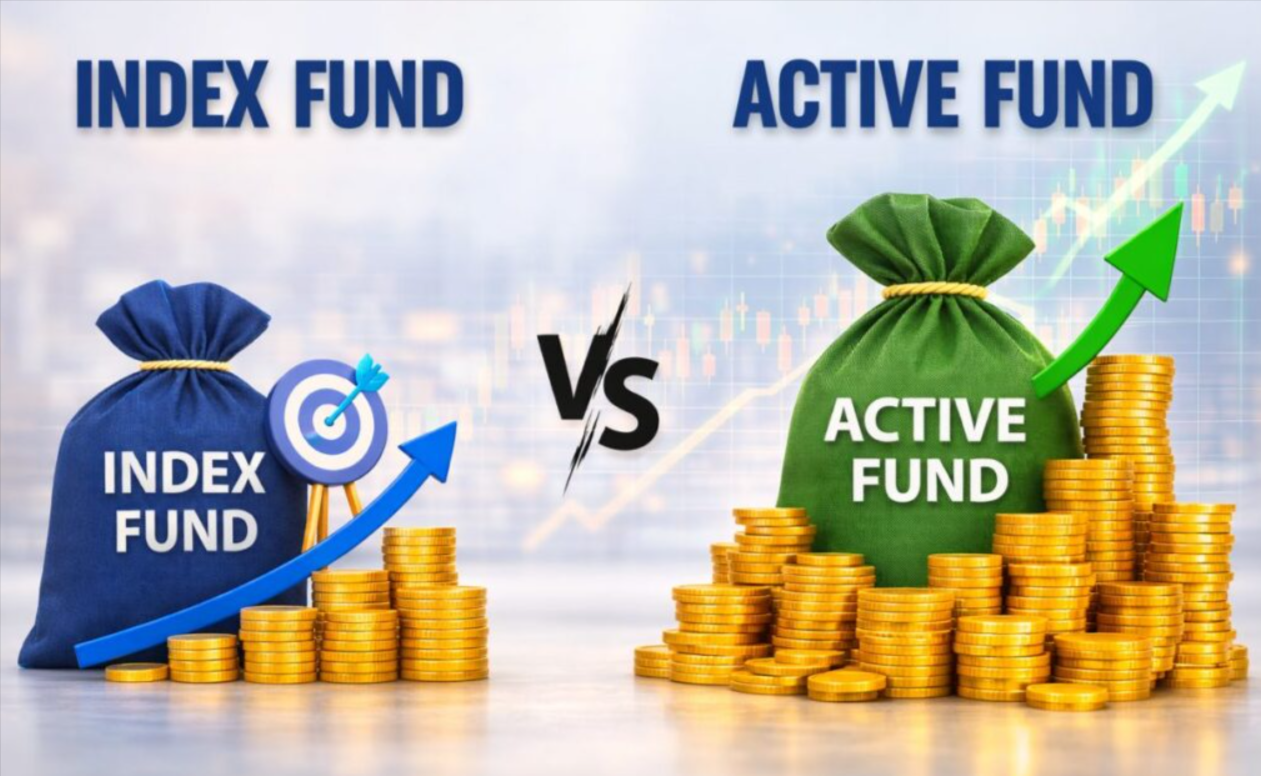
Index Funds vs Active Funds: Can Fund Managers Outperform the Nifty 50 Over Time?
When investing in equity mutual funds, one of the most common debates revolves around active funds and index funds. Active funds aim to outperform a benchmark through security selection and portfolio management, while index funds seek to replicate the performance of a market index.
This naturally leads to an important question: can a fund manager consistently outperform the Nifty 50 over long periods?
The answer is not straightforward. While some fund managers may outperform a benchmark during certain periods, maintaining that outperformance consistently across different market cycles can be challenging.
Understanding the difference between active and index funds
Before comparing active and passive investing, it helps to understand the role each approach plays in a portfolio:
Active funds
Active funds are managed by investment professionals who research companies, sectors and market trends before making investment decisions. Their portfolios may change over time as managers adjust holdings based on their investment approach and market outlook.
Index funds
Index funds follow a passive approach by aiming to track the performance of a specific market index rather than outperform it. They generally invest in the same securities as the underlying index, subject to tracking differences and fund-related expenses.
Why is consistent outperformance difficult?
Several factors can influence whether a fund manager is able to outperform a benchmark over long periods:
Markets continuously evolve
Economic conditions, interest rates, regulations and business trends can change significantly over time. As a result, an investment approach that appears effective during one market phase may not necessarily produce similar outcomes during another.
Competition is intense
Professional fund managers often have access to extensive research, analytical tools and market information. Since many market participants are studying similar data, finding opportunities that may potentially lead to benchmark outperformance over extended periods can be challenging.
Costs matter
Active funds typically have higher expense ratios than index funds because they involve research, portfolio management and ongoing monitoring. These costs can influence overall returns, which means a fund manager may need to generate additional potential outperformance to offset expenses.
Why costs and simplicity often enter the discussion
One reason index funds have gained attention is their relatively straightforward approach. Since they aim to track an index rather than select individual securities, portfolio changes are typically linked to changes in the underlying index.
This approach may result in lower fund management costs compared to many actively managed funds. Over long investment horizons, costs can influence overall investment outcomes, which is why some investors consider expense ratios when comparing fund options.
The case for index funds
Index funds have gained attention because they follow a relatively straightforward approach. Instead of relying on a fund manager to select stocks, they aim to track a specific market index by investing in the same securities that form part of that index.
They also typically have lower expense ratios than many actively managed funds, as they do not require extensive research or frequent portfolio changes. Lower costs may influence long-term investment outcomes over time. However, index funds remain exposed to market movements. If the underlying index declines, the value of the fund may also fall, subject to tracking differences and fund-related expenses.
The case for active funds
Active funds offer the possibility of deviating from benchmark weights and selecting securities that a fund manager believes may perform differently from the broader market.
This flexibility allows managers to respond to changing market conditions, adjust sector exposures and implement different investment strategies.
Whether these decisions ultimately result in potential benchmark outperformance can vary across time periods and market cycles.
Which approach may be suitable?
The choice between active and index funds depends on several factors, including investment objectives, risk tolerance, cost considerations and personal preferences.
Some investors prefer the simplicity of passive investing, while others value the flexibility offered by active management.
Rather than viewing the two approaches as competing options, some investors consider them as different tools that may serve different purposes within a broader investment framework.
It is important to remember that neither approach guarantees outcomes, and both remain subject to market risks.
Conclusion
The question of whether a fund manager can consistently outperform a benchmark does not have a universal answer. While some managers may outperform during certain periods, the ability to sustain that outperformance across different market cycles can be challenging. Rather than focusing solely on performance comparisons, investors may find it useful to understand how active and index funds work, their costs, associated risks and how they align with individual financial goals and investment horizons.
Past performance may or may not be sustained in future.
Mutual Fund investments are subject to market risks, read all scheme related documents carefully.
This document should not be treated as endorsement of the views/opinions or as investment advice. This document should not be construed as a research report or a recommendation to buy or sell any security. This document is for information purpose only and should not be construed as a promise on minimum returns or safeguard of capital. This document alone is not sufficient and should not be used for the development or implementation of an investment strategy. The recipient should note and understand that the information provided above may not contain all the material aspects relevant for making an investment decision. Investors are advised to consult their own investment advisor before making any investment decision in light of their risk appetite, investment goals and horizon. This information is subject to change without any prior notice.
The content herein has been prepared on the basis of publicly available information believed to be reliable. However, Bajaj Finserv Asset Management Limited does not guarantee the accuracy of such information, assure its completeness or warrant such information will not be changed. The tax information (if any) in this article is based on prevailing laws at the time of publishing the article and is subject to change. Please consult a tax professional or refer to the latest regulations for up-to-date information.